
Coventry manufacturing centre installs £1.3m solar thermal system to cut emissions
 N Scott
Posted On November 9, 2026
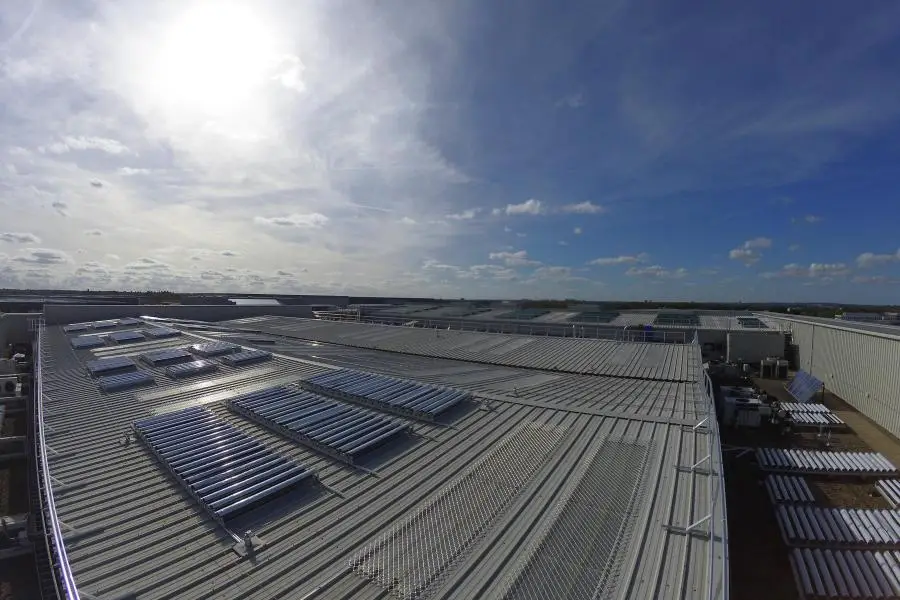
The Manufacturing Technology Centre (MTC) in Coventry has installed what is reported to be the UK’s largest solar thermal system, following a £1.3m investment intended to reduce the energy costs and carbon emissions associated with heating and cooling its research facilities.
The installation at Ansty Park comprises 1,965 VirtuHOT solar thermal collectors developed by British technology company Naked Energy. With a combined thermal output of up to 786kW, the system is expected to reduce the centre’s annual carbon emissions by 37 tonnes of carbon dioxide equivalent.
Unlike conventional solar photovoltaic panels, which generate electricity, solar thermal collectors capture energy from sunlight to produce heat. At the MTC, that energy will be used for space heating and hot water throughout the year, as well as driving an absorption chiller to provide cooling during warmer months.
An 8,000-litre water tank will store thermal energy generated by the collectors, allowing the facility to use the heat when required. The arrangement is designed to reduce dependence on conventional energy supplies and limit exposure to changes in energy prices.
The MTC is a manufacturing research and technology organisation that works with businesses to develop and test production processes, automation and industrial technologies. Its Coventry campus provides facilities for research and development, supporting manufacturers seeking to introduce new technologies into commercial production.
The solar thermal installation also provides a practical example of how renewable heat technology can be incorporated into an industrial research facility, where heating, cooling and hot water can represent a substantial proportion of energy demand.
Joe Darlington, chief innovation solutions officer at MTC, said: “At MTC, our role is to turn innovation into practical solutions for industry. By making this investment, we are reducing our emissions while demonstrating how British technology can help manufacturers become more sustainable and resilient.”
The project was delivered by engineering specialist SHEco Group in partnership with Naked Energy, which develops solar thermal technology for commercial and industrial applications.
Christophe Williams, co-founder and CEO of Naked Energy, said: “The installation tells a clear story about where British manufacturing is heading. On the demand side, MTC, an organisation shaping the future of UK industry, has chosen to put renewable heat at the heart of its site. On the supply side, it’s British-engineered technology, designed and built in the UK, that is delivering it at record scale.
“Industry and business have long presented the hardest sectors to decarbonise, particularly when it comes to heating and cooling. This project shows what can be achieved when renewable solar heat is designed as part of a modern system, resulting in increased efficiency and lower emissions. The energy transition isn’t a distant ambition. It’s gaining real speed, and solar thermal is ready to play its role in it.”
The investment comes as industrial businesses examine alternatives to gas-fired heating and conventional cooling systems. Heat accounts for around a third of UK greenhouse gas emissions, making industrial heating an important area for efforts to reduce energy consumption and emissions.
Adam Clark, commercial director at SHEco Group, said: “Many of our customers are asking how they can reduce their reliance on gas, and this project gives them a real-world example of what’s possible. Our partnership with Naked Energy combines British-designed technology with practical turnkey installation expertise, and the MTC scheme shows what that can achieve at scale.”
The Coventry installation will allow the MTC to operate a large-scale solar thermal system within an active manufacturing research environment, providing an example of how the technology could be applied at other industrial sites.
TechSparx previously reported on the Manufacturing Technology Centre’s role in establishing the West Midlands Robotics and Autonomous Systems Cluster, a collaboration with the University of Birmingham intended to increase the adoption of robotics and automation across regional industry. The cluster, established in 2024, had grown to 18 partner organisations by April 2025. The new solar thermal installation extends the MTC’s work beyond manufacturing technology development into demonstrating how renewable energy systems can operate within industrial facilities.
Image source: MTC